On May 12, Webb Management presents its long-awaited feasibility study to the Tomball EDC and City Council. The 110-page packet examines a project most residents have been hearing about for three years and seen very little of: the 4.6-acre Legacy Square campus, the former First Baptist Church property on Oxford Street.
Their verdict, in a sentence: build it — carefully, slowly, and only after someone else agrees to run it.
The three-building bet
The study divides the site into three pieces, each with its own job and its own operator:
- The Sanctuary → Performing Arts Hall. An 800–1,000 seat flexible venue for music, theatre, comedy, dance, and speakers.
- The 1949 Chapel → Visual Arts Center. Exhibition space curated with the Art League and Pearl Fincher, plus roughly 2,500 sf carved out for a potential restaurant tenant.
- Fellowship Hall → Arts Education Center. Classrooms, dance studios, music rehearsal halls, and offices for a nonprofit arts educator.
An outdoor “event hub” stitches the three together, doubling as passive park between festivals.
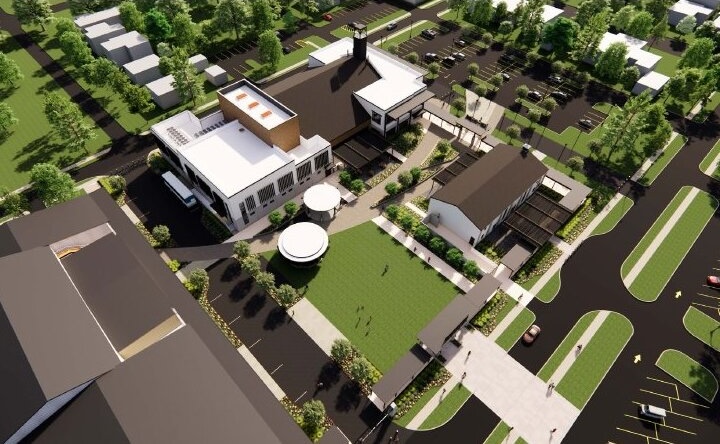
Aerial rendering of the proposed campus. Credit: Studio Red Architects.
The market case
Webb’s conclusion rests on two numbers. By 2030, 1.5 million people will live within a 30-minute drive of Legacy Square. And the regional inventory of mid-sized halls — the 900-to-1,200-seat range that touring acts and community theatre most want — has a documented gap.
The study also lines up a roster of groups that have already expressed interest in renting:
Notable in that list: Main Street Crossing, the 150-seat Old Town venue, is named as a likely “preferred or exclusive presenting partner” for the main hall. The study also highlights interest from Theatre Under the Stars in Houston as a potential education partner.
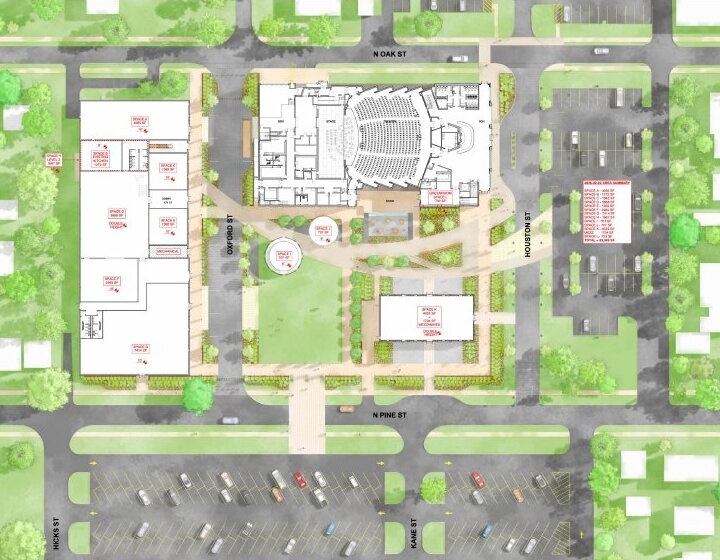
Proposed site plan showing the sanctuary (top center), chapel and fellowship hall (left), and surface parking on Pine Street. Credit: Studio Red Architects.
The money
The capital budget scenario includes a $25,000,000 placeholder — Webb is clear this is not a construction estimate. Based on that figure, the model projects:
- $36.4 million in one-time economic output during construction
- 144 construction person-years of employment
- $5.8 million in annual economic activity once operating
- 40.8 ongoing annual person-years of employment
- $1.77 million in new audience spending each year
The operating side is leaner. If all three buildings are leased at the rates Webb suggests, total estimated rent collected by the EDC works out to $623,830 a year.
The study notes plainly that this income “could be used to support some amount of borrowing to fund the renovation, but only a portion of the total capital requirement.” Translation: rent will not pay for the build out. Public grants, a private capital campaign, and naming-rights deals are all on the funding plan.
The timeline
Webb’s recommended approach has three parallel tracks: secure operators first, raise money second, design and build third. The order matters — the consultants flag “mitigating risk: find operating partners before spending any money” as a guiding principle.
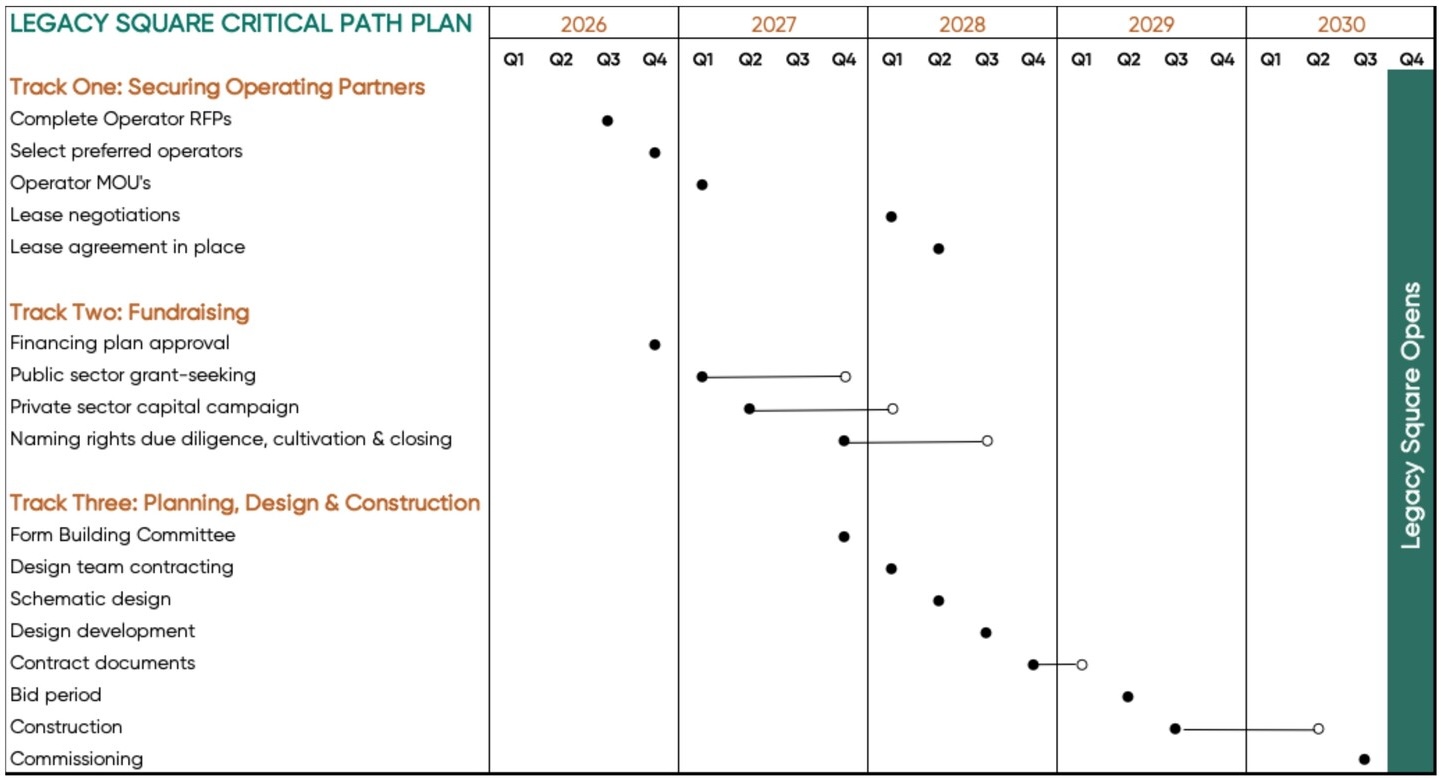
The recommended critical path runs four years. Credit: Webb Management.
Under that plan, Legacy Square opens in late 2030. A phased opening — one building at a time — could compress that, depending on what comes first.
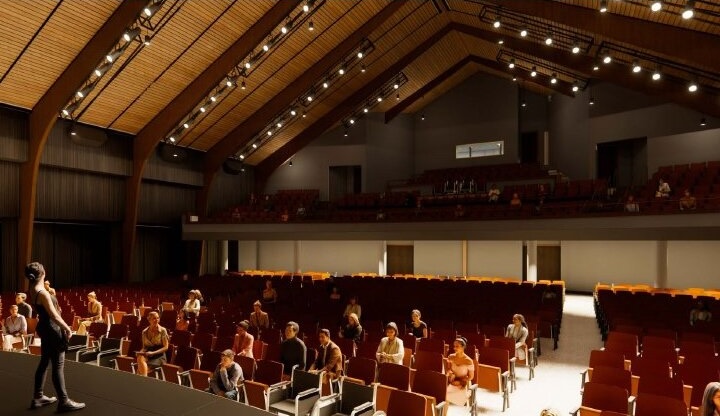
Proposed performing arts hall in the former sanctuary. Credit: Studio Red Architects.
The takeaway
Webb’s study is a green light, but not yet a groundbreaking. It shows the market is there, the buildings can work, and the campus aligns with both the EDC’s strategic plan and the city’s June 2025 comprehensive plan goal of treating Old Town as a “cultural center and historic asset.”
It also says, with equal clarity, that nothing should be built until operators have signed agreements (MOUs), grants have been secured, and a capital campaign is underway — and that the rent the campus will eventually generate won’t cover its construction.
Could Legacy Square be the long-overdue cultural anchor for Old Town? The EDC, the Council, and the community get to decide.
The full feasibility study and presentation are on the agenda packet for the May 12 joint meeting.